


The most important security story from October 20–21 was not any single vulnerability. It was the simultaneous failure of several layers that enterprises routinely treat as dependable foundations.
The PHP interpreter exposed applications before their own code could defend them. GitLab’s bundled regular-expression engine created a path to unauthenticated code execution across twelve years of self-managed releases. Node.js shipped a native decompression flaw alongside several certificate-validation weaknesses. Eight intermediate certificate authority keys were recoverable from public certificates because their private values contained almost no entropy. Railway disclosed unauthorized access to systems holding customer environment variables, with plaintext secrets obtained for some customers.
These incidents crossed different vendors and technologies, but they converged on one operational lesson: application controls inherit the security of everything below and around them. Authentication in a PHP application cannot stop exploitation that occurs during runtime initialization. A well-configured HTTPS client cannot establish trustworthy identity when its certificate store accepts a compromised issuing authority. A carefully permissioned application cannot protect credentials that an attacker extracts from the hosting platform’s secret plane.
The useful response is therefore larger than “patch faster.” Organizations need an exposure model that accounts for runtime internals, embedded dependencies, cryptographic trust, control-plane concentration, and the recovery work that follows credential compromise. The events of these two days show exactly what that model must cover.
Pre-Authentication Flaws Move the Boundary Below the Application
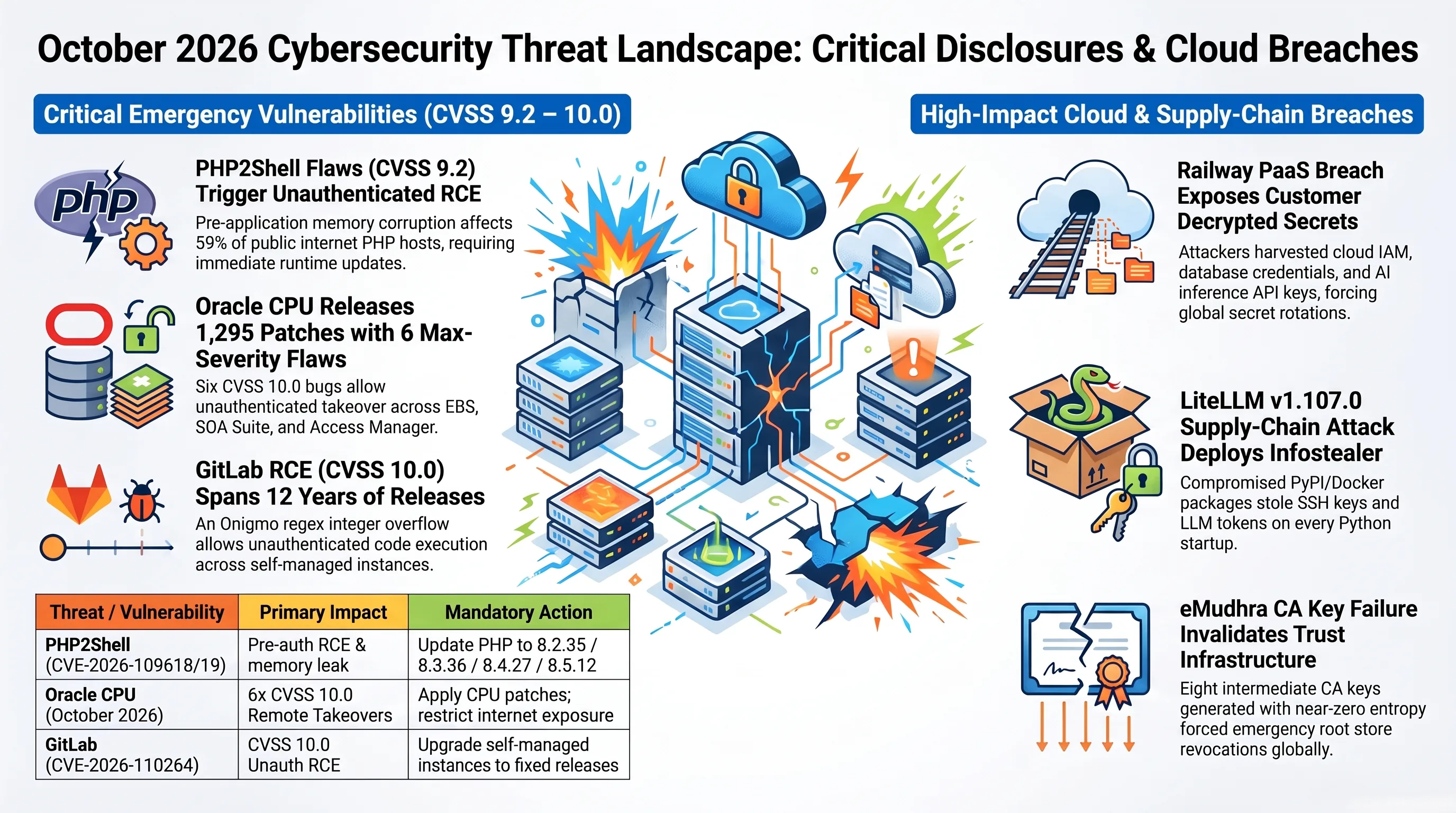
The pair of PHP vulnerabilities known as PHP2Shell, CVE-2026-109618 and CVE-2026-109619, demonstrates why vulnerability location can matter more than the framework running above it. Both flaws live in the C-level PHP engine and affect request initialization, error recovery, and persistent worker state. Exploitation can occur before PHP hands control to WordPress, Laravel, Drupal, Nextcloud, phpMyAdmin, or custom application code.
That placement makes application authentication, authorization, input validation, and framework patches irrelevant to the initial exploit path. A hardened application can still be compromised by a request that corrupts the interpreter responsible for starting it.
The shared mechanism begins with PHP’s response to an out-of-memory condition. When a fatal allocation failure interrupts an internal operation, the engine can use longjmp() to escape the current execution path. The problem is what remains behind. PHP may later process structures that were only partially initialized, or it may retain pointers to request-owned memory after that memory has been released.
In CVE-2026-109618, a carefully sized request can force memory exhaustion while PHP is initializing internal state. Control jumps away before initialization finishes. During shutdown, cleanup code then treats incomplete state as valid, creating an opportunity for memory corruption and control-flow hijacking.
CVE-2026-109619 carries dangerous state across requests. A fatal error can interrupt cleanup before global pointers are reset. The request memory is freed, but the persistent worker still holds dangling references. A later request reaching the same worker can trigger a use-after-free before ordinary request initialization clears the stale state.
The default-enabled session upload progress feature is particularly important. PHP processes multipart upload metadata early, even when the application never calls session_start(). That creates a broadly reachable path in configurations that operators may not realize are using the feature. PHP 8.5 also included a separate path involving retained fatal-error backtrace state.
Deployment architecture changes the probability and shape of exploitation, but not the need to patch. Apache mod_php keeps workers alive across requests and presents the clearest risk. PHP-FPM often terminates workers after early initialization failures, reducing some simple exploit paths, yet remains exposed when a fatal condition occurs after startup and poisons reusable worker state. A large FPM pool can make it harder for a follow-up request to land on the same poisoned worker. It does not remove the flaw.
The vulnerabilities also support a quieter outcome than a process crash. Researchers demonstrated live worker-memory disclosure, with heap contents exfiltrated through unusually large PHPSESSID response cookies. Exposed memory can contain passwords, API keys, database connection strings, session tokens, and private keys. Pointer disclosure can also weaken Address Space Layout Randomization (ASLR), making reliable code execution easier.
The disclosure process sharply reduced the defender’s lead time. CVE identifiers and affected versions appeared publicly before the planned release. A proof-of-concept video was accidentally published. Patched container images appeared several hours before official packages, giving attackers a clean artifact to compare with vulnerable builds. By October 21, broad scanning and exploitation attempts were being reported.
The immediate action is unambiguous: upgrade to PHP 8.5.12, 8.4.27, 8.3.36, or 8.2.35, or install a verified operating-system vendor backport. Restart Apache, PHP-FPM, and other persistent workers after updating so the patched code is actually loaded. PHP 5.4 through 7.3 have no upstream fixed release and should be removed from public exposure while migration proceeds. PHP 7.4, 8.0, and 8.1 require a supported distribution or commercial backport if they cannot yet be upgraded.
Temporary mitigations are risk reduction, not remediation. The source report identifies disabling session.upload_progress.enabled and, on PHP 8.5, fatal_error_backtraces as ways to close known paths. Reverse proxies should enforce request-size limits. Defenders should avoid operating-system RLIMIT_AS or RLIMIT_DATA constraints as a workaround because forced allocation failures can activate the vulnerable path. Teams should also test memory_limit and post_max_size after patching: the corrected behavior terminates workers more aggressively when they exhaust memory, which may expose poorly sized production workloads.
The same below-the-application pattern appeared elsewhere. GitLab’s CVE-2026-110264 is an integer overflow in the bundled Onigmo regular-expression engine. A crafted expression can corrupt heap memory during compilation and execute code in the Ruby process. The vulnerable code reached back to GitLab 7.0, so GitLab issued fixes across seven branches rather than its normal three. Self-managed installations must move to 19.5.1, 19.4.3, 19.3.6, 19.2.9, 19.1.9, 19.0.10, or 18.11.13. GitLab.com and GitLab Dedicated were already patched, but an October 12 self-managed update is not sufficient.
Node.js CVE-2026-111497 follows the same structural pattern in the Brotli decoder. A malformed stream can produce an out-of-bounds native write whenever a service passes attacker-controlled Brotli data into the affected decoder, potentially executing before application code can validate the decompressed content. Node.js 26.12.1, 24.22.1, and 22.23.4 contain the fix. Those releases also repair DNS and TLS validation weaknesses, predictable random values in serialized startup snapshots, HTTP response desynchronization behavior, and permission-model bypasses. Services that accept Brotli input or initiate outbound TLS connections should treat the release as an infrastructure update, not a routine dependency refresh.
Cryptographic Trust Can Fail Without a Network Breach
The eMudhra incident exposed a different kind of foundational weakness. Eight intermediate certificate authority (CA) private keys did not need to be stolen from an internal system. The published certificates contained public keys derived from private values so small that researchers could recover those private keys by exhaustively testing a trivial search space. One private key was reportedly the integer 4; the other seven were integers below 256.
Mozilla engineers recovered the keys within two hours of receiving the initial report. The computational problem was effectively nonexistent. Anyone who derived one of the six TLS-issuing private keys could create fraudulent certificates for arbitrary domains. The two code-signing intermediates created a parallel software-trust risk. Cross-signing through Sectigo’s AAA Certificate Services root expanded the number of trust paths that defenders had to remove.
The failure reportedly originated in an April 2025 key ceremony. A defect in the hardware security module wrap-and-unwrap procedure produced a second weak key set, and those weak public keys were exported into the certificate ecosystem. A FIPS 140-2 Level 3-certified hardware security module was present, but the surrounding ceremony and output validation still failed. Certification of a component cannot substitute for validating the keys produced by the full process.
Revocation was unusually difficult because browser and server ecosystems do not consume trust changes in the same way. Firefox can receive OneCRL updates through Remote Settings. Many backend runtimes use bundled certificate collections or compiled verification logic. A browser fleet may therefore reject a fraudulent chain while an API service continues to accept it.
The Go response to CVE-2026-111943 illustrates the operational consequence. Go 1.27.3 and 1.26.10 hardcode the compromised key hashes into the standard library verifier. Updating the compiler on a build host does not change binaries that already exist. Every affected Go service must be rebuilt and redeployed before it gains the protection.
Other ecosystems require their own updates. Firefox and Network Security Services (NSS) shipped fixed versions, Linux distributions updated ca-certificates, Python’s certifi package removed the affected root, Composer’s CA bundle explicitly distrusted the intermediates, and Node.js refreshed its bundled CA data. RHEL administrators initially received manual trust-store instructions pending package updates.
This creates an inventory problem that conventional vulnerability scanners may only partially answer. Defenders need to know which applications use the operating system trust store, which ship their own CA bundle, which are statically linked, and which containers contain old bundles that will survive a host update. A clean desktop-browser report says very little about outbound TLS verification inside an old container or Go binary.
The required response is therefore fourfold:
- Patch operating-system CA packages and browser/NSS components.
- Update language-specific bundles such as
certifi, Composer CA packages, and Node.js. - Rebuild and redeploy Go binaries with Go 1.27.3 or 1.26.10.
- Test important outbound integrations from the workload itself, not only from an administrator’s browser.
The eMudhra case also changes how organizations should assess key ceremonies. Teams should verify public/private key consistency, entropy and generation output, certificate constraints, custody records, and the exact artifacts exported for publication. “The key came from an HSM” is provenance, not proof that the published key is safe.
Cloud Secret Stores Turn One Intrusion Into Many Incidents
Railway’s October 21 disclosure shows the concentration risk created by platform-managed environment variables. The company confirmed that an unauthorized party accessed encrypted customer variables and obtained decrypted plaintext for a subset of customers. Railway described the activity as part of a broader campaign targeting cloud platforms to reach AI inference providers.
Environment variables are convenient because applications can consume secrets without committing them to source code. The security boundary, however, moves into the platform control plane. A single environment can contain database URLs, cloud service-account keys, payment credentials, registry tokens, GitHub tokens, and API keys for OpenAI, Anthropic, xAI, and OpenRouter. Access to the platform’s decryption path collapses those separate service boundaries into one collection point.
Railway automatically invalidated and regenerated its S3 storage credentials for affected workspaces. It also invalidated GitHub OAuth connections and removed GitHub personal access tokens used as private registry credentials. Those actions reduced exposure quickly, but they could not rotate every third-party secret stored by every customer.
Customers still had to regenerate managed PostgreSQL and MySQL credentials; revoke and recreate AI provider, Stripe, AWS, and Google Cloud keys; reconnect GitHub integrations; redeploy services that needed regenerated Railway bucket credentials; and update hardcoded values in external CI/CD systems or local tooling. Audit logs and provider billing records became part of the investigation because a successfully used API key may leave evidence with the upstream provider rather than on Railway.
That response sequence is a useful model for any secret-store compromise:
- Identify all credentials in scope. Export an inventory of variable names, integrations, projects, environments, and service owners. The inventory must include references copied into external pipelines or local tools.
- Contain according to risk. Revoke actively abused or highly privileged credentials immediately. Where availability requirements prevent immediate revocation, issue and deploy replacements first, then revoke the exposed credentials without delay.
- Prioritize by power and liquidity. Cloud IAM keys, database credentials, payment secrets, package-registry tokens, and high-quota AI keys can produce immediate damage.
- Redeploy consumers. A rotated secret provides no benefit if the running workload still holds the old value or never resolves the regenerated reference.
- Inspect upstream evidence. Review authentication events, API usage, model-token consumption, billing anomalies, object changes, repository access, and database logs.
- Preserve the timeline. Platform actions performed on a customer’s behalf can resemble attacker activity. Railway’s automated changes appeared under the
Railway Staffactor type, so investigators needed to distinguish containment from intrusion.
Rotation is also an architecture test. Long-lived static secrets require coordinated replacement across every consumer. Workload identity, short-lived tokens, narrowly scoped service accounts, and separate credentials per environment reduce the blast radius and make revocation more precise. A centralized vault remains valuable, but it should not become a warehouse of durable, highly privileged keys.
The ConnectWise Cloud Backup compromise extended the same concentration problem into Microsoft 365. An attacker obtained an active API secret belonging to a multi-tenant ConnectWise application. Because customers had delegated permissions to that vendor application, the credential could be used to request access inside multiple customer tenants without stealing a separate secret from each one. Exchange Online, Teams, SharePoint Online, Microsoft Graph, Partner Center, and backup data all fell within the potential permission set.
For managed service providers, the incident is a reminder that delegated applications are part of the identity perimeter. Review enterprise application consent, effective Graph permissions, token issuance, service-principal sign-ins, and access to mail and document stores. Vendor access should be scoped, monitored, and removable without dismantling the customer environment.
Enterprise Patching Must Follow Reachability and Consequence
Oracle’s October Critical Patch Update contained 1,295 patch entries covering 1,209 CVEs across 33 product families. A list that large can overwhelm normal change management. Six vulnerabilities carried CVSS 10.0 scores, and several more unauthenticated flaws scored 9.8. The practical question is not how to treat every entry equally. It is how to find the systems where unauthenticated reachability meets privileged enterprise function.
The highest-priority group includes Oracle E-Business Suite, SOA Suite, Access Manager, JD Edwards EnterpriseOne Orchestrator, WebLogic, APEX, and exposed database services. These systems often sit near finance, payroll, procurement, identity, integration buses, and operational workflows. Compromise can cross component boundaries because the affected service already holds broad database or application permissions.
CVE-2026-101809 affects the E-Business Suite Workflow Notification Mailer. CVE-2026-91216, CVE-2026-91221, and CVE-2026-91231 affect SOA Suite fabric and adapter components over T3, IIOP, or HTTP. CVE-2026-87337 strikes the Oracle Access Manager authentication engine. CVE-2026-91299 affects JD Edwards orchestration. Each received a maximum CVSS score and requires no authentication.
CVE-2026-101767 in the E-Business Suite Application Object Library is a 9.8 unauthenticated SQL injection that can be chained to code execution. When immediate patching is impossible, the source report recommends removing the EBS web tier from public exposure, restricting access through allowlisted reverse proxies or a VPN, and removing /OA_HTML/AppsTCFServer from the EBS URL firewall allowlist. Those controls reduce reachable surface while the formal update moves through testing. They do not replace the CPU.
Patch prioritization should therefore combine at least four facts:
- Can an attacker reach the vulnerable protocol? Inventory HTTP, HTTPS, T3, IIOP, TLS, ZeroMQ, and administrative endpoints from both external and internal network positions.
- Is authentication required before the vulnerable code runs? Pre-authentication paths receive priority even when the application is believed to be private.
- What authority does the process hold? An ERP workflow process, identity server, root-running AI cache, or hypervisor management plane can turn one exploit into organizational compromise.
- Can a compensating control actually intercept the path? A web application firewall cannot repair a malformed certificate chain in an outbound client, and application authentication cannot stop runtime initialization corruption.
LMCache’s CVE-2026-105192 is a compact example. In multiprocess mode, the vLLM accelerator accepted unauthenticated ZeroMQ messages and deserialized them with Python pickle. A crafted message could execute commands as root in the official container. Version 0.5.6 replaces pickle with a typed message format and binds the administrative HTTP server to localhost. Because the wire format changes, servers and workers must be upgraded together. Simply hiding the public web interface does not protect an exposed ZeroMQ port.
Active exploitation should move an issue ahead of its numeric score. Ransomware groups were using CVE-2026-0257, a GlobalProtect authentication-override cookie validation bypass, months after Palo Alto Networks issued patches. Attackers used forged cookies to bypass multifactor authentication, reached VMware vCenter, disabled execInstalledOnly protections on ESXi, and extracted credentials from domain-controller virtual disks. Endpoint detection inside the guest operating system could not observe offline access to the VMDK.
Defenders should verify remediated PAN-OS releases, enable strict authentication-override cookie HMAC validation, and search for the proof-of-concept artifacts listed in the source report, including WINDOWS-LAPTOP-001, DESKTOP-GP01, GP-CLIENT, aa:bb:cc:dd:ee:ff, and 00:11:22:33:44:55. The investigation must extend into vCenter and ESXi logs. A clean endpoint alert queue cannot clear activity that occurred at the hypervisor layer.
Build the Response Around Dependencies, Not Product Names
The events of October 20–21 exposed a dependency graph that ordinary asset lists often miss. Applications depend on runtimes. Runtimes embed native libraries and certificate bundles. Statically linked services preserve old security decisions inside binaries. Cloud platforms decrypt customer secrets. Vendor applications hold delegated identity across many tenants. Hypervisors can reach data that guest security tools cannot see.
An effective response program should map those relationships directly.
Start with runtime provenance. Record the PHP SAPI, Node.js release line, GitLab distribution, container base image, operating-system backport source, and restart or redeployment requirement. “Package installed” is not the same as “patched code executing.” Persistent workers and immutable images make that distinction operationally important.
Add trust-store provenance. Record whether each workload uses the host store, a language bundle, a container copy, a browser-managed list, or compiled verification code. Include rebuild requirements. The eMudhra revocation showed why a single “certificates updated” checkbox cannot represent the fleet.
Map secret lineage. For every credential, identify the issuer, scope, storage location, consumers, rotation method, expiry, and available usage logs. Use workload identity and short-lived credentials where supported. Separate production, staging, and development keys so a single platform event does not expose every environment at once.
Finally, model control-plane reach. Review cloud platforms, CI/CD systems, source-code hosts, multi-tenant vendor applications, identity providers, vCenter, and other management layers as privileged infrastructure. These systems can bypass the controls deployed inside individual applications and endpoints.
The goal is not to predict which vendor will publish the next emergency advisory. The goal is to know which foundational layer failed, what inherits trust from it, and which recovery action actually changes the state of the running environment. October’s disclosures made that dependency visible. Mature security programs should keep it visible after the emergency patch window closes.