


Why Doesn’t Canada Have Its Own Credit Card?
Someone recently asked me why Canada doesn’t just issue its own credit card to detach itself from the United States. The question came up in the context of the Canada–U.S. trade dispute: why keep relying on American payment companies when we could have a Canadian alternative?
I had pieces of an answer. There would be lending decisions, assets and liabilities on somebody’s balance sheet, cooperation between banks, and considerable technology underneath the card. I also expected a connection to sovereign data centres. But I couldn’t explain how those pieces fitted together, or which ones actually made the question difficult. I started looking into it out of interest.
The distinction that reorganized everything was the difference between issuing credit and operating a card network.
Visa and Mastercard do not lend cardholders the money they spend. The issuing institution extends the credit, sets the customer’s borrowing terms, and carries the risk that the customer will not repay. Both companies explain that separation in their own financial disclosures. Their network businesses connect the institutions involved in a payment. Visa’s 2025 annual report, Mastercard’s 2025 annual report.
A Canadian bank can therefore issue a Canadian-dollar credit card, lend to a Canadian customer, and retain that customer relationship while using an American company’s card scheme. The nationality of the lender and the ownership of the payment network are separate questions.
Consider an illustrative C$100 purchase at a Canadian shop. Four parties have distinct responsibilities:
| Party | Role in the purchase |
|---|---|
| Cardholder | Buys the goods and owes the issuing institution under the credit agreement. |
| Issuer | Provides the credit account, decides whether to approve the transaction, and bills the cardholder. |
| Merchant | Supplies the goods and accepts the payment under its acquiring agreement. |
| Acquirer | Provides the merchant’s access to card acceptance and handles the merchant side of processing and payment. |
The network connects the issuer and acquirer and supplies the common framework under which they transact. This is called the four-party model even though the network is another organization in the picture: the name refers to the four participants it brings together. Additional processors and gateways can sit between them without changing those underlying roles. Mastercard describes these participants explicitly in its business-model disclosure.
The shop does not need a separate technical and legal arrangement with every bank whose customers might walk through its door. Its acquirer connects it to an acceptance system. The issuer joins that same system from the other side. The network’s rules give both institutions a basis for trusting the messages, meeting their obligations, and resolving disagreements.
That common framework includes much more than sending an approval request. A card scheme supplies the acceptance brand, participation rules, technical requirements, security obligations, fee arrangements, and procedures for disputed transactions. Its processing infrastructure routes messages, supports authorization, exchanges completed sales records, calculates amounts owed, and coordinates settlement. These functions are reflected in the networks’ published operating rules.
The dispute system is part of the product. If a cardholder says the C$100 purchase was unauthorized, or the goods never arrived, the institutions need agreed evidence requirements and deadlines. A chargeback is a mechanism through which the issuer can challenge a transaction and seek recovery through the acquiring side, subject to those rules. The merchant can contest the claim. Somebody must maintain that process and decide the cases that remain unresolved. A functioning switch alone cannot do that institutional work.
My initial thoughts about balance sheets still mattered, but they belonged to different businesses. The issuer funds a cardholder’s borrowing and manages consumer credit risk. The network needs resources to operate and arrangements for the risks created between its participants. Creating the second business does not require replacing the first with a government lender.
Canada also has a domestic starting point in Interac. Its debit network demonstrates that Canadian institutions can operate shared payment infrastructure. But the distinction needs care: debit usually draws on a deposit account, while credit draws on an agreed borrowing facility. Debit does not mean that final payment between banks occurs at the same instant the customer’s account is debited. The Bank of Canada identifies Interac debit payments among the items cleared through the Automated Clearing Settlement System, Canada’s retail batch system. Bank of Canada payment-system overview.
Nor is separating authorization from clearing an unavoidable property of lending. It is a transaction design used by familiar card products, including some debit products. An Interac expansion could reuse capabilities and relationships, but adding a general-purpose credit offering would still require the corresponding product rules, processing, acceptance, disputes, and settlement arrangements.
The question became more concrete: what would Canada need to control to operate the network through which its banks provide that service? Sovereignty, in this setting, means authority over those functions and the practical ability to keep performing them. The infrastructure gives that authority something to act on.
Authorization: The Work Before the Beep
At the shop, the customer taps the card. The terminal passes an authorization request through the merchant’s processing chain to the acquirer and network. The network identifies the issuer and routes the request. The issuer evaluates the credential, account status, available credit, and fraud signals, then returns an approval or decline. That response travels back to the terminal. Visa’s authorization glossary describes this round trip and the network’s ability to respond on an issuer’s behalf.
For a typical credit purchase, approval places a hold against available credit. The shop can complete the sale, but the final exchange of money between institutions comes later. The C$100 has acquired an authorization, a transaction record, and consequences for the customer’s spending capacity. Those records now have to survive everything that happens next.
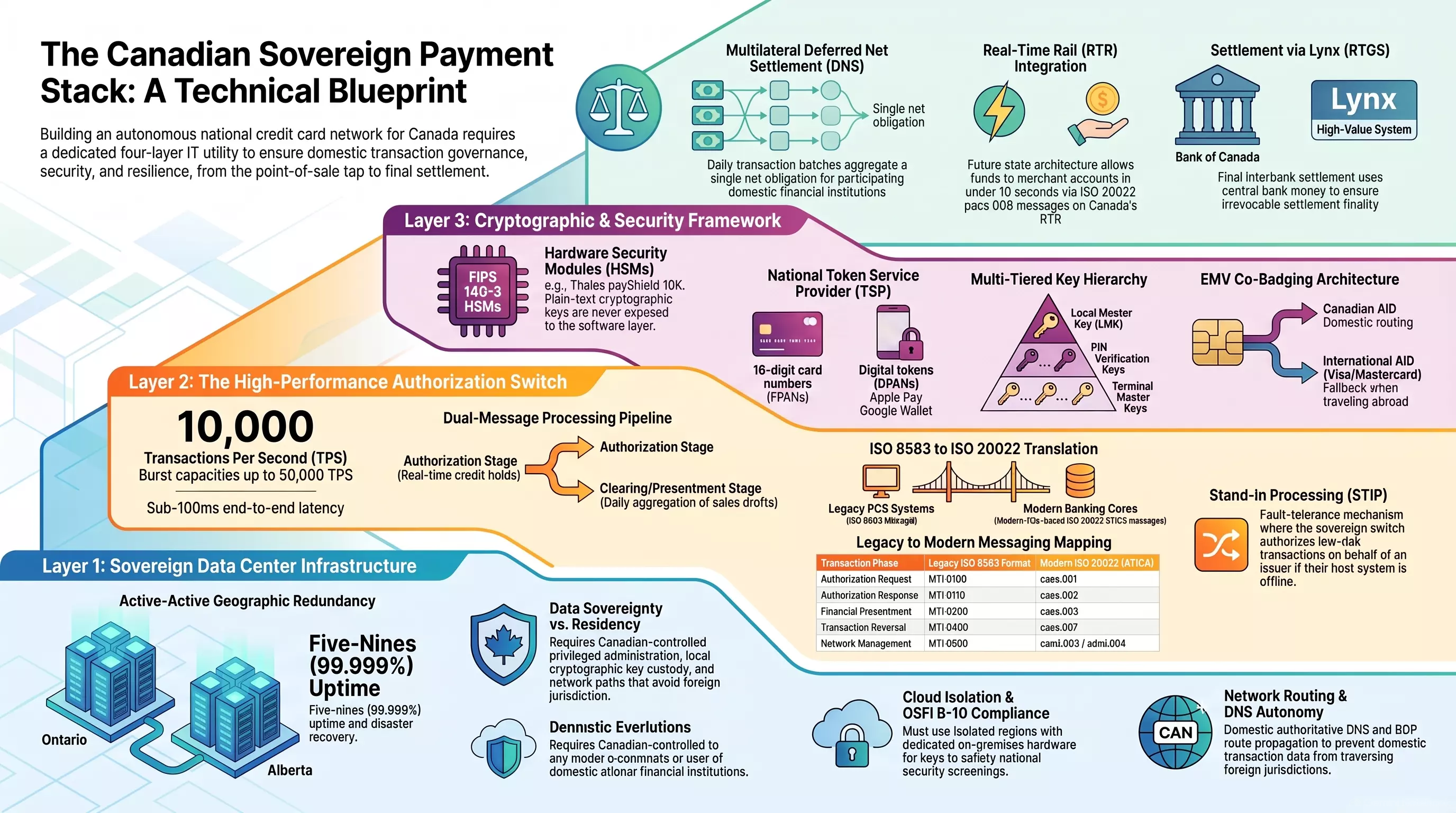
The central routing engine is the payment switch. To operate one nationally, Canada would need a service whose performance holds up during busy shopping periods, equipment failures, software releases, and issuer outages. Capacity at an otherwise healthy primary site would be insufficient if losing that site left the remaining infrastructure unable to carry the traffic.
A credible design would spread processing across geographically separate Canadian sites and test whether the surviving capacity could handle the required load. It would also need recovery from a compromised software or administrative environment. Two buildings can fail together if they depend on the same broken update, identity system, or management platform. Geographic redundancy answers only one class of failure.
The scale is substantial, but annual transaction totals can mislead. Payments Canada recorded 7.5 billion credit-card transactions in 2024. Dividing that rounded total across the leap year’s seconds produces an average of roughly 237 purchases per second. That is an illustrative calculation, not a sizing requirement: purchases concentrate in busy periods, and one purchase can generate authorization, retry, reversal, and completion traffic. A national design would be sized against measured peaks and failure scenarios. Payments Canada’s 2024 payment findings.
It also has to understand the systems already installed. ISO 8583 is the standards family used for card-originated transaction messages. ISO 20022 provides a common model for financial messages and is used in Canada’s modernized payment infrastructure. Existing issuer and acquirer interfaces would need compatible adapters, while settlement interfaces would follow the requirements of the Canadian rail involved. Payments Canada documents its ISO 20022 adoption.
This does not mean converting every tap directly into a bank transfer message. An authorization and a settlement instruction perform different jobs. The integration burden is preserving their meaning, identifiers, and reconciliation relationships across systems that represent them differently. Choosing a newer standard for the core leaves the existing terminal, gateway, and bank estate to be connected.
Routing needs its own authoritative records. Card-number ranges identify issuing institutions; processors must know which ranges belong to which network and where to send them. The Canadian scheme would need to govern that directory and distribute changes reliably. It would also need consistent response meanings: an issuer timeout cannot safely become a customer decline, and an unknown result cannot simply be treated as permission to try indefinitely.
The revealing case is stand-in processing. If an issuer cannot answer, the network may make an authorization decision under limits and conditions established for that issuer. Visa describes this as a response to planned or unplanned issuer outages and network problems. Visa’s stand-in processing explanation.
Imagine that the shop’s customer has usable credit, but the issuing bank’s authorization host is unavailable. A domestic stand-in service might permit a low-value purchase under the issuer’s agreed policy. That service would need to track cumulative approvals during the outage so that many individually small purchases could not evade the overall limit. It would need to retain the decisions and deliver them for reconciliation when the issuer recovered.
The network is exercising delegated financial authority with incomplete access to the issuer’s live state. The rules must determine the permitted transactions, the limits, and who bears losses if something goes wrong. The operator does not automatically become liable for every fraudulent stand-in approval; liability follows the applicable agreements and rules. Mastercard’s transaction-processing rules illustrate how issuer parameters and stand-in obligations become formal scheme requirements.
Writing the decision engine is one task. Operating that delegated authority, accounting for every decision, and enforcing the resulting obligations is a continuing business.
Trust: The Hardware Behind a Genuine Card
An authorization request is useful only if the institutions can trust the credential and protect the sensitive information passing between them.
EMV, named for Europay, Mastercard, and Visa, is the global specifications framework behind interoperable chip payments. A chip transaction can carry a cryptogram: a cryptographic value calculated from transaction information and secret key material. It provides evidence that a legitimate credential participated and helps detect altered or replayed data. It reduces particular fraud opportunities; it does not prove that every purchase is legitimate or eliminate every way a payment can be abused. EMVCo’s chip-payment framework.
Much of the sensitive cryptographic work in payment processing happens inside a hardware security module, or HSM. This is a specialized appliance with a protected boundary for keys and cryptographic operations. The processing application asks it to perform a permitted operation and receives a result. Secret keys are kept out of ordinary application memory and databases in readable form.
A national scheme would need a managed estate of these devices, including redundancy, secure backups, replacement procedures, and carefully separated access. The Payment Card Industry Security Standards Council’s HSM security requirements describe the security boundary and controls underlying this class of equipment.
Key custody begins with procedures as much as hardware. A key ceremony is a controlled, documented process for establishing or managing sensitive keys. Dual control means that sensitive actions require more than one authorized person. Split knowledge means that, where people handle key components, no one individual holds enough information to reconstruct the whole secret. The council defines these controls in its security glossary.
A master key can protect working keys used by the service. There would be multiple key hierarchies and security domains across a complete scheme, including issuer-controlled keys; a single national master key does not unlock every function. Nor does secure custody require every key to remain forever inside the first device that generated it. Protected key transfer and recovery are necessary to replace equipment without either exposing secrets or losing the ability to process payments.
PIN translation makes this tangible. Consider a purchase in which the issuing bank verifies the customer’s personal identification number, or PIN, online. The acquiring side and issuing side may use different encryption keys. To carry the protected PIN between those cryptographic domains, an HSM translates the encrypted PIN block: it decrypts under the incoming key and re-encrypts under the outgoing key within its protected boundary. The application receives the translated encrypted result, not the readable PIN. Documented PIN-translation behaviour.
That operation does not occur for every tap. Some transactions require no PIN; others use verification on the card or a customer’s device. Where online PIN translation is involved, however, readable PIN data is handled inside a particular protected device. The crucial questions are who can authorize its use, who administers it, who controls its keys, and which legal authorities can reach the operator. Putting the device in Canada addresses location. It leaves the other questions to be answered.
Even a strong security certificate has a defined scope. The Federal Information Processing Standards, or FIPS, provide a framework for cryptographic-module validation. Canada’s Cyber Centre explicitly says that validation does not assess a module’s supply chain or a vendor’s reliability, reputation, or ownership. A validated module supplies evidence about specified security requirements; it does not establish Canadian control. Canadian Centre for Cyber Security’s validation guidance.
The card and terminal estate then have to recognize the scheme. A payment application has an application identifier, or AID, that distinguishes it when the card and terminal select a supported application. The scheme needs an identifier strategy, card profiles, chip applications, and terminal software that implement its transaction rules. An internationally recognized identifier enables identification; it does not make every terminal accept the application automatically.
For contactless acceptance, a kernel is the terminal software that conducts the relevant payment interaction. A scheme could license an implementation or adopt an available specification such as CPACE, the Common Payment Application Contactless Extension developed by European domestic card schemes. Its published terminal-kernel specification describes its relationship to EMV. Access to a specification still leaves implementation, licensing conditions, testing, and deployment to resolve.
Certification follows the payment into the merchant’s environment. Level 1 concerns the physical interface; Level 2 concerns the payment kernel; Level 3 tests the integrated acceptance device with the merchant and acquiring infrastructure. EMVCo supplies the Level 3 testing framework, while participating payment systems define their test requirements.
Some terminals could receive software and parameter updates. Others might require a different kernel, additional capacity, or replacement. Every supported combination needs a tested path into service. The workload extends across manufacturers, processors, acquirers, and merchants long after the Canadian switch itself can approve a transaction.
Digital Cards and the Dependencies That Remain
The same C$100 purchase could begin with a phone instead of plastic. A network intended for ordinary Canadian use would have to work in that environment from the outset. Payments Canada counted 3.4 billion mobile contactless transactions in 2024, an increase of 28 per cent from 2023. That is a specific year’s growth, not a rate that can be assumed to continue indefinitely. Payments Canada’s mobile-payment findings.
The credential used by a tokenized phone payment differs from the number on the physical card. Payment tokenization replaces the primary account number, or PAN, with a substitute payment value whose permitted use can be restricted to a device, merchant, or payment scenario. A stolen token is therefore less broadly useful than an unrestricted account number. EMVCo defines those tokenization roles and restrictions.
The token service provider creates and manages the relationship between the token and the underlying account. A token vault stores that mapping securely. One account can have several tokens: for example, credentials associated with different devices or merchants. The service must govern provisioning, use restrictions, suspension, replacement, and deletion. Those controls allow an individual credential to be managed without necessarily disrupting all the others associated with the account. EMVCo’s tokenization explanation.
Adding a card to a wallet is consequently a coordinated enrollment process. The wallet requests provisioning, the issuer participates in deciding whether the enrollment is legitimate, and the token service establishes the usable credential and its controls. In Apple’s implementation, the device-specific account number and associated payment material are provisioned into a Secure Element, a protected chip on the device. Apple’s provisioning documentation describes the parties and security boundaries involved.
The Canadian scheme could own its vault, administer its token service, and retain control of the domestic routing. It would still need commercial and technical arrangements to make its cards available in Apple Pay, Google Wallet, or Samsung Wallet. Owning the credential service does not confer a place in another company’s wallet, control over its user interface, or authority over its operating-system changes.
Hardware dependence also survives. Apple documents the Secure Element and Secure Enclave coordination used for payment authorization. Other platforms use their own security architectures. Canada could govern the payment credential while relying on a handset and its security mechanisms designed and supplied elsewhere. These are separate control boundaries within the same purchase.
Online checkout adds further work. Gateways need to recognize and route the scheme’s card and token ranges. Stored credentials, recurring payments, refunds, and account updates must continue working across the transaction’s life. EMV 3-D Secure provides a framework for exchanging information between the merchant and issuer to authenticate an online purchaser, with additional challenges where appropriate. It addresses authentication; it does not itself extend credit, authorize every purchase, or determine every liability outcome. EMVCo’s 3-D Secure overview.
Ordinary online card payments can operate without network tokenization. But physical-card processing alone would not provide a competitive wallet and online credential service. The Canadian operator would need either to operate these capabilities or secure them under arrangements consistent with its control objectives.
Travel introduces another boundary. Co-badging allows a card to carry a domestic payment application alongside an international one. At a Canadian merchant equipped and contracted to accept the domestic application, selection and routing arrangements could direct the purchase onto the Canadian network. At a foreign terminal supporting only the international application, that supported application would be selected. The European Central Bank describes domestic and international co-badging in its card-market analysis.
The terminal is matching supported applications; it is not simply making a geographical decision. A foreign terminal may discover a Canadian application identifier without having the software, acquiring connection, or agreement needed to accept it. A Canadian terminal could likewise route internationally if the domestic application or required configuration were missing. Wallets and websites need their own arrangements; plastic co-badging does not automatically solve digital routing.
Domestic preference would also have to fit the applicable commercial and regulatory rules. Canada’s existing Payment Card Industry Code of Conduct protects merchant acceptance choices and consumers’ ability to establish default payment options on devices. It does not establish a blanket requirement that a hypothetical Canadian credit application always receive priority. Such a routing model would need to be deliberately established.
The result could be a Canadian-issued card used at a Canadian merchant, authorized and cleared under Canadian rules on Canadian infrastructure. The same card used abroad could depend on a foreign network’s acceptance, fees, operating rules, and continued cooperation. Even the domestic service would retain dependencies on international specifications, handset platforms, and equipment suppliers.
That is a meaningful capability with a defined perimeter. Domestic control can be evaluated against that perimeter; worldwide independence is a much larger proposition.
Clearing and Settlement: Where the Money Moves
The shop’s approval still has to become a completed financial transaction. Authorization answers whether the purchase may proceed under the applicable rules. Clearing establishes the financial obligations arising from completed transactions. Settlement discharges those obligations through the transfer of the settlement asset.
In the familiar dual-message card model, the merchant captures a completed sale and its acquiring side submits the financial record for clearing. The final amount may differ from an earlier authorization—for example, where a transaction began with a preauthorization. The network needs rules for matching records, handling duplicates and reversals, and applying the appropriate fees. Mastercard’s processing rules distinguish these authorization and clearing requirements.
A clearing engine can then net the obligations. For a simplified illustration, suppose one institution owes another C$100 from one set of purchases, while C$70 is owed in the other direction. Netting reduces those two obligations to a C$30 balance, before fees and other adjustments. A multilateral arrangement performs the corresponding calculation across all participants under its rules. Netting reduces the amount of money that must move; the transaction-level records still have to remain reconcilable.
Interchange is one part of that calculation: generally a payment from the acquiring side to the issuing side. It is distinct from the network’s own charges and the acquirer’s price to the merchant. Visa describes this separation in its annual report. A Canadian scheme would need a fee methodology and an engine that applies it consistently. Ownership of the network alone does not decide what that methodology should pay issuers or charge merchants.
Canada already has infrastructure on which the resulting interbank transfers could settle. Lynx, operated by Payments Canada, is Canada’s high-value payment system. It uses real-time gross settlement: individual payments settle with finality, rather than awaiting a later multilateral net settlement within Lynx. Participating institutions use it for transfers arising from obligations between them. A card scheme could calculate net card positions and arrange for the resulting payments to settle through that existing foundation. Payments Canada’s Lynx overview.
The arrangement would need agreed access, accounts, instructions, and settlement procedures. Smaller institutions need not all hold direct central-bank access; settlement agents can provide indirect participation where the relevant rules permit it. The Bank of Canada’s settlement-account policies explain the access framework and the role of central-bank money.
This provides a domestic settlement foundation without requiring an entirely new one. It also has its own suppliers: Payments Canada identifies Swift as Lynx’s financial messaging provider. Canadian ownership of the settlement institution is compatible with international technology dependencies, another reason to examine the actual control arrangements rather than stop at an ownership label.
Lynx is designated under the Payment Clearing and Settlement Act, which provides statutory protections for designated systems’ settlement rules. A new card scheme could not assume that using Lynx automatically extended those protections to every obligation in its own rulebook. Its clearing arrangement, legal enforceability, and potential designation would require their own assessment. Payment Clearing and Settlement Act, section 8.
The Real-Time Rail, or RTR, would add a different capability: an always-available system for instant payment exchange, clearing, and settlement. As of September 6, 2026, Payments Canada schedules its launch for Q4 2026, with sequenced participant onboarding. It is forthcoming infrastructure, and its launch would not by itself create card authorization, merchant disputes, or a revolving-credit product. Payments Canada’s RTR launch plan.
The gap before settlement carries a financial consequence. Suppose an issuer fails after purchases have been approved but before the relevant obligations have settled. There is money due to the acquiring side. Whether the network, another participant, or a specific guarantee arrangement must make good on it depends on the contracts—but a scheme cannot offer reliable settlement while leaving that question unanswered.
A possible default waterfall would specify an ordered set of resources: first the failing participant’s pledged collateral, then a prefunded scheme reserve, then defined contributions from surviving participants. This is a design example, not a legally prescribed sequence for a proposed Canadian network. Exposure limits, prefunding, settlement frequency, and guarantees would determine what resources were needed. The Bank of Canada’s standards for prominent payment systems require arrangements addressing credit losses, collateral, liquidity, and participant default.
Credit risk and liquidity risk require different answers. A loss is an obligation that cannot ultimately be recovered. A liquidity shortfall means money is unavailable when payment is due, even if valuable collateral or a recoverable claim exists. A reserve can absorb loss; committed liquidity can help complete settlement on time. Selling collateral during stress introduces its own timing and valuation problems.
Central-bank support cannot be written into the final tier as an assumed rescue. Section 7 of the Act gives the Bank of Canada powers concerning designated systems, including settlement guarantees and liquidity loans. Those are discretionary powers, not an automatic promise to finance a new card scheme or absorb its losses. Payment Clearing and Settlement Act, section 7.
Nor would a new retail network inevitably be designated systemically important. VisaNet, Mastercard’s relevant systems, and Interac’s Inter-Member Network were designated prominent payment systems in 2023. The distinction affects the applicable oversight framework. A Canadian network would be assessed against its actual role and risks. Bank of Canada’s designation announcement.
The engineering decision about settlement timing therefore produces an institutional obligation. Settling net positions through a real-time system does not erase the exposure accumulated before those payments reach it. Somebody must measure that exposure, limit it, finance it, and enforce the agreements when a participant fails.
What Canada Would Have to Control
This was where the connection to sovereign data centres became clearer for me. The buildings host the work. The ability to govern and sustain that work depends on a more specific collection of rights, assets, and operating capabilities.
For the domestic network described here, the control requirements would look like this:
| Control point | What Canadian control would mean in practice |
|---|---|
| Scheme rulebook and participation | Authority to set access conditions, transaction rules, fee methodology, dispute procedures, and liability allocation. |
| Cryptographic trust | Control of the scheme’s key domains, signing authorities, HSM administration, recovery material, and authorized custodians. |
| Tokens and account mapping | Authority over token issuance, permitted uses, vault access, suspension, and credential continuity. |
| Identifiers and routing | Stewardship of allocated identifiers and authoritative directories, plus enforceable domestic routing arrangements. |
| Transaction information | Control over collection, access, retention, processing locations, permitted uses, and disclosure. |
| Settlement and default arrangements | Enforceable participation, funding, collateral, liquidity, and loss-allocation obligations. |
| Continued operation | Domestic expertise and usable rights to maintain, recover, and replace critical systems if a supplier withdraws. |
These are the control requirements I draw from the transaction’s dependencies, rather than a statutory definition of sovereignty. Some involve ownership. Others involve legal authority, allocated identifiers, contractual rights, and demonstrated operating capability. An issuer would still retain its own customer relationship and credit decisions; Canadian scheme control need not centralize every bank function.
Commercial suppliers could provide switching software, HSMs, fraud tools, databases, and operational platforms. The sovereignty question would sit in the terms and architecture of that supply. Could a Canadian team restore the service? Would the necessary licenses survive the supplier’s withdrawal? Could another provider use the existing data and interfaces? Who could revoke administrative access or prevent a critical component from starting?
Source-code escrow—an arrangement to release a supplier’s code under defined conditions—can help preserve an option. Possessing the code alone does not make that option executable. The operator also needs build instructions, dependencies, rights to use them, suitable equipment, and people able to maintain the system. A switch that can be replaced only by abandoning every card or token would leave a much weaker continuity option than the procurement contract might suggest.
The practical test is what remains operable when a particular relationship ends. For a payment network, that obligation extends below the switch and token vault into the infrastructure that keeps both running.
Sovereign Data Centres and the Infrastructure Beneath the Network
This is the connection to sovereign data centres that I had expected at the beginning, but had not fully understood. Owning the payment rules and the cryptographic keys still leaves a national service dependent on the environment in which those rules are executed and those keys are used. Canada would need control across that environment for the domestic autonomy described here to hold.
Consider a proposed architecture that puts an HSM in Google’s cloud. Even assuming the Canadian operator alone controls the payment keys, that answers only the cryptographic part of the question. It leaves the ownership and administration of the surrounding infrastructure to be established. Who controls the accounts that operate the switch? Who can change the network configuration, restore the databases, approve privileged access, or interrupt the service? Where would recovery take place if that cloud environment became unavailable?
Those are questions about the proposed arrangement, not conclusions that follow from either the Google name or the presence of an HSM. A protected key can remain confidential while the payment service that needs it becomes unavailable. Control of the keys and control of the infrastructure are separate requirements.
The management systems are part of the sovereign boundary
A cloud environment has a data plane, where applications process information, and a control plane, through which infrastructure is provisioned and managed. The control plane determines such things as which resources exist, how they are configured, and who may administer them. Keeping the payment database in Canada would establish its residency. It would not, by itself, establish Canadian control over those management functions.
Identity systems are particularly consequential because they decide who is recognized as an authorized operator. A Canadian payment network could have Canadian engineers and Canadian servers while still relying on an externally administered identity service for privileged access. The sovereignty assessment therefore has to include directories, administrator credentials, multifactor authentication, certificate authorities, and emergency access procedures. The question is whether Canada retains the authority and capability to administer the service through an external disruption.
Support and monitoring belong inside the same assessment. A manufacturer’s remote troubleshooting session may require powerful access. Diagnostic files and logs can contain sensitive information. Security monitoring may send those records into a separate service, with its own administrators, locations, and subcontractors. A domestic production database would provide an incomplete picture if its diagnostic copies and operational records were routinely handled elsewhere.
For the card network, these dependencies would need explicit boundaries: who can enter the environment, what they can do, which information can leave, who approves exceptional access, and what evidence is retained. Domestic operation would require people capable of handling incidents and routine maintenance, together with controlled arrangements for any outside assistance. Merely putting a Canadian organization on the contract would not supply those capabilities.
Domestic facilities require an operating capability
The boundary also reaches into physical infrastructure. A payment switch needs electricity, cooling, communications, and secure access to its equipment. Redundant power feeds, batteries, generators, fuel arrangements, and geographically separated facilities are part of the service’s ability to remain available. Their design has to reflect the outages the network is expected to survive.
Communications can introduce dependencies beyond the data centre. The Domain Name System, or DNS, directs systems to network addresses. Providers that mitigate distributed denial-of-service attacks, which attempt to overwhelm a service with traffic, may process communications through globally distributed infrastructure. Carrier routing and remote-access services also need examination. Data stored in Canada does not guarantee that every communications path or protective service remains within the same boundary.
There are trade-offs in drawing that boundary. Restricting traffic to domestic infrastructure can limit the available protection and recovery options. Creating one national platform for payments, government, health care, and other critical services can also concentrate the consequences of a failure. Domestic control would still require independent failure and recovery arrangements; concentrating everything under one Canadian operator would not automatically deliver them.
Software and equipment need continuing attention as well. Operating systems, databases, virtualization platforms, and device firmware all require maintenance. Even servers contain separate management processors with powerful access to the underlying hardware. Their administration and update mechanisms are part of the infrastructure being entrusted with the payment service.
Canadian operating capability would consequently include the ability to obtain, validate, stage, and deploy updates under domestic change control. Local software repositories and controlled release processes can support that capability, but they require expertise and resources and can complicate timely patching. The same applies to hardware replacement and specialist support. Sovereignty has an ongoing operating cost because the infrastructure keeps changing after it is purchased.
Recovery is where control becomes demonstrable
A second Canadian data centre would offer limited independence if restoring it still required an unavailable foreign identity service, management portal, or specialist. Backups need their own accessible keys, administrators, software, and recovery procedures. The recovery environment must be assessed as a complete operating environment, rather than simply a second place to store copies.
A recovery exercise in which the Canadian team restores an essential payment function without access to a designated external dependency would make that capability observable. It would expose the difference between having a backup and being able to use it when the normal operating arrangements have failed.
The legal boundary remains relevant. Canada’s federal private-sector privacy law, the Personal Information Protection and Electronic Documents Act, or PIPEDA, does not impose a blanket requirement that payment data stay in Canada. The originating organization remains accountable when information is transferred for processing; provincial and sector-specific requirements also need consideration. Canadian residency and domestic operating control would therefore be explicit policy and architecture requirements for this network. Privacy Commissioner’s cross-border processing guidance.
Corporate ownership, subcontracting, and foreign legal exposure would have to be considered alongside technical access. The Privacy Commissioner explains that contracts cannot override a foreign jurisdiction’s laws and that foreign organizations operating in Canada may themselves face orders from their home countries. A Canadian server address does not resolve that exposure. Privacy Commissioner’s guidance on foreign access.
None of this requires Canada to manufacture every processor or write every software component. It requires a deliberate account of which external dependencies remain, what authority they confer, and how essential operations can continue if they are withdrawn. Purchased technology can support sovereign infrastructure when Canada retains the necessary operating authority, expertise, and continuity options. Those conditions have to extend through the supporting infrastructure, rather than ending at the payment application’s interface.
The HSM secures a critical part of a transaction. A sovereign infrastructure capability also keeps the switch reachable, the operators authenticated, the facilities running, and the recovery environment usable. That is the broader national capability beneath the idea of a Canadian credit card.
The Version That Skips the Card
A credit purchase does not have to travel over a card scheme at all. Changing that architecture would change the payment machinery Canada needs, while leaving the underlying infrastructure-control questions in place.
Europe provides a useful example of that architectural direction. The European Payments Initiative began with plans for a pan-European card and digital wallet. It ultimately moved forward with Wero, a service using instant account-to-account payments. The institutions remained involved in the payment service, while the architecture moved away from building a new card scheme.
A Canadian credit overlay on the RTR could separate the borrowing from the payment in a similar way. As a hypothetical design, the customer selects a credit facility in a banking application; the bank checks the borrowing limit and initiates an instant payment to the merchant; the resulting debt is booked against the customer’s credit account. The interbank payment uses available settlement liquidity while the customer repays the lender under a separate agreement. RTR supplies the payment rail; the participating institutions would have to build the lending product and checkout service.
That architecture would avoid a dedicated card-authorization switch, card-application deployment, and EMV card-token infrastructure for that payment path. Card interchange would not be intrinsic to it. It would still require routing, authentication, fraud controls, participant integration, operating revenue, and liquidity. Immediate final settlement reduces the particular deferred interbank exposure described earlier; it does not eliminate consumer credit risk or every payment risk.
The C$100 purchase also still needs a remedy if the goods never arrive. Finality means the original settled transfer is not simply unwound as though it never happened. A refund or successful dispute can instead produce a new payment or reimbursement obligation. The service would need rules for evidence, deadlines, adjudication, recovery from the merchant, and who pays when recovery fails. A chargeback-like protection can be built above an instant rail; it is not supplied merely by settling quickly.
The complexity changes location. The merchant receives money sooner, while lending, protection, and dispute obligations remain with institutions around the transfer. International use adds another set of relationships, whichever payment architecture carries the purchase.
Crossing a border still requires an acceptance arrangement
A credit facility connected to the RTR would not automatically work at a shop in Tokyo. The borrowing account could remain Canadian, but the shop would need a way to accept the payment and receive funds through its own financial institution. Linking domestic bank-transfer systems is a different undertaking from connecting card networks.
For a hypothetical purchase priced in yen, an international bank-transfer service would need to connect the Canadian payment to a Japanese receiving institution, arrange currency conversion, and establish how each side is funded and settled. It would also need agreed handling for unsuccessful payments, fraud, refunds, and disputes. A merchant checkout would have to recognize the service. Making a cross-border transfer possible does not, by itself, create a retail acceptance network.
Work on these connections already exists. The Bank for International Settlements’ Project Nexus developed a model for linking domestic instant payment systems through a standardized connection, rather than requiring a separate technical integration for every country pair. Its work includes scheme governance and a commercial model alongside the technology. That illustrates the additional international layer a service needs; it is not an existing international acceptance arrangement for the proposed Canadian credit overlay. BIS overview of Project Nexus.
A Canadian card scheme would have another route: negotiate acceptance through a foreign card network. In an illustrative arrangement with a Japanese partner, the merchant’s acquirer could send an authorization request through that partner to the Canadian scheme and then to the Canadian issuer. The issuer would ordinarily make the credit decision, while the foreign partner supplied access to the merchant. Clearing records, currency conversion, settlement funding, and the treatment of disputes would follow the agreements between the participants.
That resembles mobile roaming: the customer retains a home service while another operator provides reach in another market. The analogy has limits. Payment partners must agree who owes whom, which evidence establishes a disputed purchase, and who bears a loss. Translating message formats cannot settle those questions. Nor does routing authorization back to Canada mean that the foreign merchant’s transaction data never exists abroad.
A service could also retain a card-network option for travel while using bank transfers domestically. In that case, the international purchase would use a different payment path. The useful distinction is between control of domestic commerce and the relationships needed to reach foreign merchants; a single consumer-facing product can contain both.
Japan built an independent card business
Japan’s JCB shows that a domestic-origin card business can acquire international reach. It is a card-network example, distinct from the proposed RTR credit overlay. JCB was founded in 1961 and began its independent international expansion in 1981. Its corporate profile describes an initial focus on merchants at destinations popular with Japanese travellers, followed by acquiring-license partnerships with local banks and financial institutions. JCB also operates card-issuing and merchant-acquiring businesses, so its corporate model differs from Visa’s and Mastercard’s network model. JCB’s corporate profile and international history.
Its overseas reach combines direct relationships with other networks’ acceptance. JCB says its cards are accepted in the United States through Discover Network and in Canada, Australia, and New Zealand through its partnership with American Express. A Japanese payment brand can therefore remain the customer’s card scheme while an American network helps make that card usable abroad. JCB’s merchant and network-partnership overview.
JCB’s history makes two features of the problem visible: international acceptance can be accumulated progressively, and independence in the home business can coexist with foreign partnerships. It demonstrates a commercial path to building a network. It does not establish that every part of Japan’s payment infrastructure is sovereign, or that a new Canadian entrant could reproduce the same result on the same terms.
Why Canada hasn’t made the same move
The question therefore cannot be why nobody has done it. Domestic card schemes exist, and services such as Wero are pursuing a different route through bank transfers. The harder Canadian question is why an independent general-purpose credit network has not emerged alongside Interac.
The evidence points to an adoption problem as well as an infrastructure problem. The Competition Bureau has identified the first-mover advantages of established payment systems as a barrier to new payment choices. My reading of the Canadian position is that those advantages help explain how a country can have capable banks, processors, and engineers without producing a new credit scheme. Competition Bureau discussion of technology-led innovation and payment competition.
The incentives reinforce one another. An issuer would have to fund integration and support a new product while retaining a credible proposition for customers who already have rewards, familiar protections, and international acceptance. An acquirer or merchant would have to enable the service before knowing how many customers would use it. Customers would need a reason to adopt it before acceptance became widespread. Each participant’s willingness to move depends partly on the others moving too.
The bank’s economics also remain distinct from the network’s. A Canadian issuer can already earn income from lending and interchange while using an international scheme. Replacing that scheme would bring conversion costs and new obligations; domestic ownership would not automatically make the issuer’s credit business more attractive. Equally, lower merchant fees would not automatically create a compelling cardholder proposition. Those interests would have to be reconciled through the product, pricing, and participation arrangements.
Canada’s existing investment in Interac gives a potential entrant assets and relationships to work with, but it also means that domestic payment capability has developed around an established debit service. Extending that foundation into credit would still require the credit-product rules, issuer commitments, merchant enablement, and international arrangements. Existing acceptance is a starting advantage; it is not consent to accept every future product.
JCB began building its business while the Japanese card market was developing. A Canadian entrant today would be asking participants to add or replace parts of an already functioning system. That difference in starting conditions helps explain the challenge without requiring a claim that Canadian banks or governments once made a single, explicit decision against payment sovereignty.
The bank-transfer alternative changes the amount and kind of infrastructure that must be built, but it leaves the same coordination problem around lending, checkout acceptance, consumer protection, and overseas use. A faster settlement rail can carry a payment once the institutions agree to provide the service. It cannot create that agreement for them.
I began with a question that sounded like issuing a card. What makes the answer substantial is the continuing commitment behind it: institutions willing to issue and accept the payment, rules that allocate the obligations, international partners that extend its reach, and Canadian infrastructure capable of sustaining the domestic service. The capability becomes real when those commitments hold together—including when an external relationship no longer does.