
The phrase biological data center invites the wrong mental picture.
It sounds like a warehouse full of brains, a DNA archive, or a conventional server facility powered by tissue instead of processors. Recent headlines have leaned into that ambiguity with claims about human neurons running artificial intelligence or living computers replacing energy-hungry graphics processing units.
The real system is both more technically credible and less mature than those descriptions suggest.
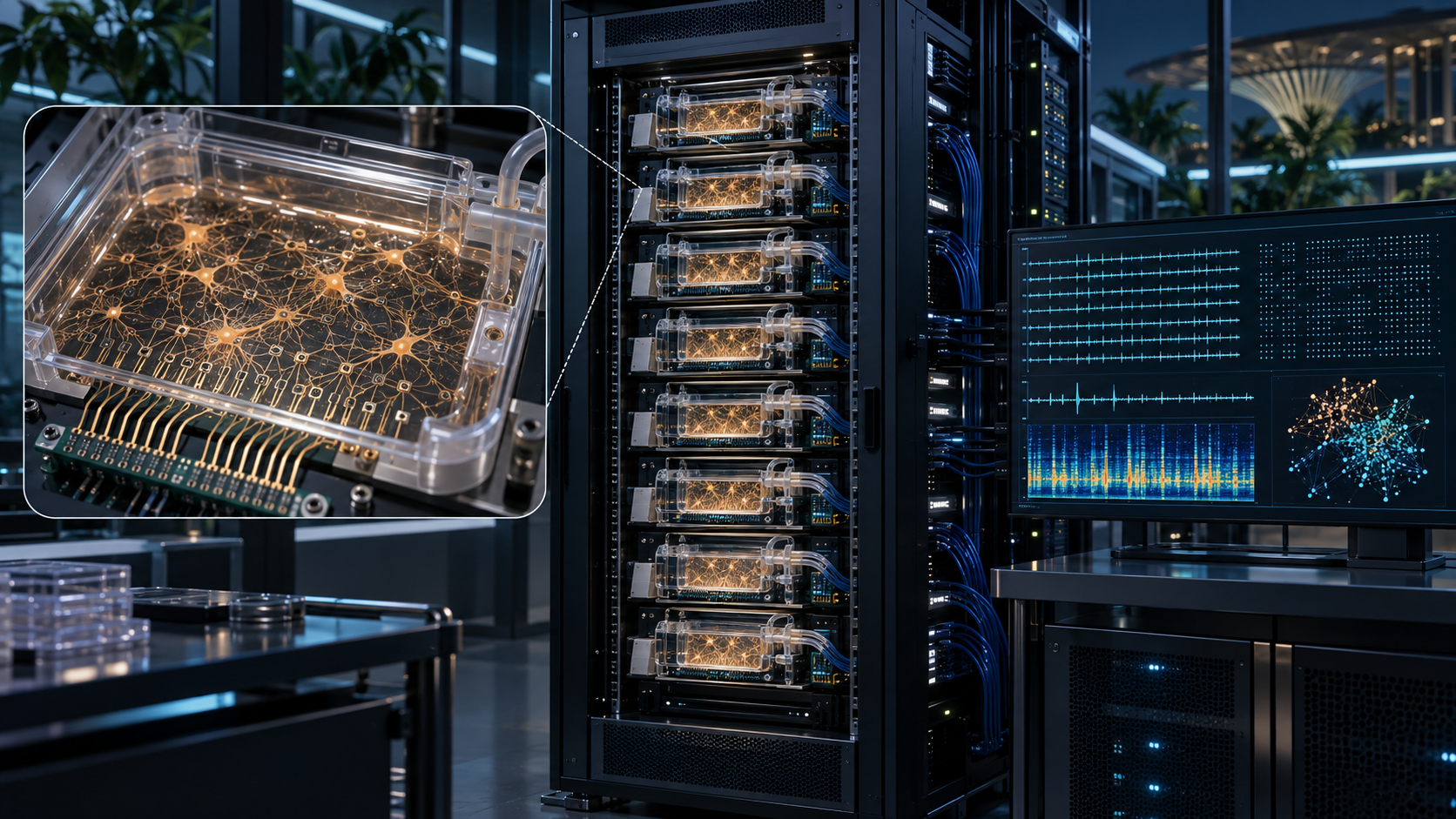
Singapore’s biological data center prototype is a rack of 20 biological-computing units built around Cortical Labs’ CL1 platform. Each unit combines a living culture of stem-cell-derived neurons, a bidirectional microelectrode interface, conventional computing electronics, and automated cellular life support. Software delivers electrical stimulation to the culture, records its electrophysiological response, and uses that response inside a closed feedback loop. The National University of Singapore (NUS) supplies the neurobiology and cell-culture expertise, Cortical Labs supplies the computing platform, and data-center operator DayOne is testing whether these systems can eventually operate as infrastructure rather than one-off laboratory experiments.
As of September 2026, the installation is a live research prototype undergoing validation. It is not a production data center, a general replacement for GPU clusters, or a distributed biological supercomputer. The partners have discussed a future commercial-data-center deployment and possible expansion to 1,000 units, but both depend on technical validation and regulatory approval. DayOne’s launch announcement describes the current system as a prototype, while its earlier partnership announcement frames performance, efficiency, governance, biosafety, and commercial integration as questions the project still needs to answer.
That is the useful story. Researchers have made living neuronal cultures accessible through a real software interface and packaged them into integrated, programmable appliances. Now they must determine whether living, variable, finite-lifetime compute substrates can be operated, benchmarked, secured, and governed with enough discipline to become infrastructure.
The Computation Happens in a Closed Biological Loop
A conventional processor represents state through engineered electronic components. A biological computer adds a second kind of state: the changing electrical and synaptic behavior of a living neuronal network.
The bridge between those domains is a microelectrode array (MEA). An MEA places many small electrodes under or near cultured neurons. The array delivers carefully controlled current pulses and records extracellular voltage changes associated with neuronal activity. Conventional software encodes information as patterns of stimulation, while the culture’s electrical response is digitized and decoded into an application action.
The operational loop looks like this:
- An application represents part of its environment as digital state.
- Software converts that state into a defined pattern of electrical stimulation.
- Electrodes deliver the stimulation to the neuronal culture.
- The living network responds according to its present connectivity, excitability, and stimulation history.
- The MEA records voltage activity and detects events such as neuronal spikes.
- Software maps those events to an action or experimental result.
- The application’s changed state becomes the next input to the culture.
Learning does not mean that a Transformer or other familiar machine-learning model has been loaded into the cells. The biological network adapts through its own plasticity, while conventional software defines the task, encodes inputs, decodes outputs, and measures performance. A large portion of the practical “program” therefore remains electronic and digital. The living culture provides an adaptive nonlinear substrate inside that program.
This architecture descends from the 2022 DishBrain research. In that work, human- and mouse-derived neuronal cultures interacted with a simplified Pong environment through a high-density MEA. Game state became patterned stimulation, neural activity controlled a paddle, and structured feedback changed the sensory input following successful or unsuccessful behavior. The peer-reviewed paper reported adaptive behavior under closed-loop stimulation. It did not establish human-like awareness, general intelligence, or superiority to digital AI. The paper’s title used the word “sentience,” but the experimentally supported result is narrower: cultured neuronal networks changed their behavior while embodied in a feedback-controlled environment. The full study in Neuron is considerably more careful than many summaries of it.
The original DishBrain instrumentation should not be treated as a specification sheet for the Singapore rack. DishBrain used a MaxOne high-density array with 26,400 physical electrodes and up to 1,024 configurable recording sites at 20,000 samples per second. Public project material does not establish that the production CL1 has the same electrode count, channel selection, analog bandwidth, converter resolution, or electrode geometry. The lineage is clear; the hardware equivalence is not.
Terminology creates another avoidable problem. Some project communications refer to “brain-like organoids,” while the strongest project-specific descriptions concern stem-cell-derived neuronal cultures grown over MEAs. A two-dimensional neuronal culture is not interchangeable with a cerebral organoid. Organoids have three-dimensional organization, different cell populations, maturation characteristics, diffusion constraints, and potentially different ethical implications. Until the partners publish a biological protocol showing otherwise, stem-cell-derived neuronal culture is the defensible description of the Singapore compute substrate.
CL1 Turns an Experiment Into a Programmable Appliance
DishBrain demonstrated a research architecture. CL1 attempts to turn the architecture into a device someone can program and operate repeatedly.
Cortical Labs describes CL1 as a self-contained biological computer. Neurons grow over a silicon interface in nutrient-rich medium. The device stimulates and records from the culture, runs applications and recordings locally, displays system status, and incorporates the systems needed to keep the culture alive. The company advertises culture operation for up to roughly six months under suitable conditions. External devices can connect through conventional interfaces, and Cortical Cloud provides remote access to CL1 systems.
The integrated life-support system changes the infrastructure problem. A CL1 is not a stateless accelerator card. Its effective performance depends on cell-line characteristics, differentiation batch, plating density, maturation, electrode coupling, medium chemistry, gas balance, temperature, contamination, age, and prior stimulation. A device failure can be electronic, software-related, biological, or some combination of the three.
The software layer is more concrete than the promotional phrase “brain cells running code” implies. The Cortical Labs developer guide exposes a Python application programming interface (API) for recording, stimulation, and closed-loop operation. Developers select stimulation channels, define current pulses, schedule events, observe detected spikes, and write experiment logic. Cortical Labs also provides a simulator intended to let code run without physical CL1 hardware and later move to a real device with minimal modification.
Reliable closed-loop experiments require more than a convenient function call. Neural activity unfolds continuously, so stimulation timing, event ordering, synchronization, and overload behavior affect the experiment itself. A delayed pulse is not simply slower computation; it may be a different biological intervention.
The 2026 CL API technical paper addresses that problem with a contract-based interface. The API defines stimulation semantics, deterministic ordering, synchronization behavior, and atomic admission of scheduled work. Applications describe what should happen and when, while the implementation handles lower-level scheduling and input/output. The paper reports sub-millisecond closed-loop interaction and microsecond-scale timing control. These guarantees are important because repeatability begins with delivering the same experiment before researchers can ask whether two cultures respond similarly.
CL1 recordings use Hierarchical Data Format 5 (HDF5), a common scientific container format. The data can include continuous voltage samples, detected spikes, stimulation events, and timestamped application data. Recording the application state alongside stimulation and neural responses provides the context needed to reconstruct what the culture experienced. Standard Python tools such as PyTables and h5py can read the files.
An HDF5 recording is still not a biological checkpoint. It documents observable activity and experimental events. It does not capture every synaptic weight, cell condition, connection, or molecular state required to recreate an identical network. A digital neural model can usually be copied by saving its parameters. The learned state of a living network remains physically embodied in that particular culture.
This difference reaches directly into resilience engineering. Replacing a failed GPU can restore a workload from stored weights. Replacing a failed CL1 culture introduces a new network with a different developmental history. The application may need to retrain, requalify, or recalibrate the replacement rather than restore it byte for byte.
Twenty Biological Computers Do Not Yet Make One Biological Supercomputer
The Singapore installation takes the next architectural step by placing 20 biological-computing units into a rack-scale deployment. That is meaningful engineering. It creates a fleet in which researchers can measure survival, variability, media consumption, activity drift, contamination rates, learning behavior, and operational overhead across multiple units.
The rack does not yet demonstrate distributed biological computation.
Public documentation explains how an application interacts with a CL1 and how code can reach arrays of devices through Cortical Cloud. It does not disclose a mechanism for combining the living state of 20 cultures into one model. There is no published protocol for dividing a task among cultures, exchanging learned representations, synchronizing their biological activity, aggregating updates, migrating biological state, or failing a workload over to an equivalent culture. Nor is there a published scheduler that assigns work based on the phenotype, age, stability, or measured capability of each biological node.
The most accurate present analogy is a pool of unusual independent accelerators. A rack can increase experimental capacity and throughput by running more cultures. That horizontal capacity is different from making a single computation larger or more capable through distributed execution.
This distinction will determine whether 1,000 CL1 units represent a data center in the computational sense or a large research facility containing many individually addressable experiments. The proposed expansion would also turn cell production into an infrastructure dependency. A thousand-node installation would need a continuing supply of mature, qualified cultures. That implies cell banking, differentiation batches, maturation capacity, sterility controls, acceptance testing, quarantine, replacement scheduling, and disposal procedures.
Silicon servers are manufactured with variation, but operators expect two units of the same model to execute the same instruction set. Biological nodes are stochastic, history-dependent systems. Two cultures receiving identical digital stimulation need not develop identical connections or emit identical spike trains. Fleet management may therefore need to characterize each node as much as provision it.
A production scheduler might eventually need to answer questions conventional cluster schedulers rarely face:
- Is this culture mature and stable enough for the requested experiment?
- Which node has the response profile best suited to this workload?
- Has stimulation history changed the node enough to require requalification?
- Can a result be reproduced across cell lines and differentiation batches?
- When should a culture be retired before degraded performance invalidates results?
None of that makes biological computing impossible. It means that scaling living compute is partly a manufacturing and metrology problem. The 20-unit prototype’s most important near-term output may be a dataset describing whether biological nodes can be standardized well enough to operate as a fleet.
Energy Claims Need a Full-System Boundary
Biological neural tissue is extraordinarily energy efficient at signaling and adaptation. That scientific fact provides a legitimate reason to investigate biological computing. It does not, by itself, establish that a CL1 rack completes useful workloads more efficiently than a GPU cluster.
An honest comparison must define the task, target accuracy, latency, and system boundary. The energy calculation must include more than electrical activity inside the neurons or power used by the electrode interface. A biological computing service also depends on pumps, temperature and gas regulation, monitoring electronics, networking, storage, conventional host computation, facility cooling, nutrient media, sterilization, upstream stem-cell culture, differentiation, consumables, and replacement of expired or contaminated cultures.
The relevant benchmark is not watts per device in isolation. It is closer to joules per reproducibly completed task at a defined accuracy and latency, including biological maintenance and facility overhead. Useful culture-hours, failure rate, training or adaptation time, and replacement cost belong beside that number.
The Singapore project is appropriately positioned as a validation environment for those measurements. DayOne’s role is valuable precisely because a data-center operator can test power distribution, environmental containment, thermal behavior, and facility integration while helping define the service procedures a commercial deployment would require. The resulting measurements will be more informative than comparing the energy consumed by neuronal signaling with the nameplate power of an entire GPU.
Claims about unusual sample efficiency deserve similar care. Follow-on research published in Cyborg and Bionic Systems compared biological neuronal networks with reinforcement-learning approaches such as Deep Q-Networks, Advantage Actor-Critic, and Proximal Policy Optimization under constrained Pong-like conditions. Such results can motivate further work, especially where learning from limited interaction is valuable. They do not show that cultured neurons outperform contemporary digital systems across general AI workloads. The sensory encoding, training rules, compute budgets, objectives, and experimental constraints differ too much for that conclusion.
No public evidence shows the Singapore rack training or serving a large language model, executing Transformer workloads, exposing a standard machine-learning accelerator interface, or delivering a meaningful floating-point-operations equivalent. Biological computing may ultimately excel at tasks that exploit adaptation, temporal dynamics, or efficient learning rather than dense matrix multiplication. Identifying those workloads is part of the research program, not a solved product-positioning exercise.
A Biological Data Center Is Also Cyber-Physical Infrastructure
CL1 combines a programmable stimulation system with a living substrate. The resulting security boundary is physical as well as digital.
An ordinary application bug can corrupt data or crash a service. In a biological computer, erroneous or malicious stimulation may also alter the living network’s behavior or damage the culture. A life-support failure can destroy computational state that cannot be restored from a file. Cloud connectivity introduces familiar identity, software-supply-chain, network, and data-governance risks alongside these new failure modes.
At minimum, a mature architecture needs three distinct control domains.
The experiment plane accepts researcher code and task inputs. It should have explicit identity, least-privilege authorization, workload isolation, logging, and limits on stimulation parameters. The API’s contract and admission semantics can enforce timing and structural correctness, but they do not replace enterprise identity and access management.
The stimulation plane converts approved requests into electrical actions. Pulse amplitude, duration, frequency, channel selection, and cumulative exposure need safety constraints below arbitrary application code. A compromised notebook should not be able to exceed device or biological operating envelopes simply because it has authenticated to the API.
The life-support plane maintains temperature, medium, gas balance, and other viability conditions. Safety-critical life-support functions should remain isolated from researcher workloads so an application crash or resource-exhaustion event cannot starve the culture. Redundant monitoring and safe failure modes become part of availability engineering.
Public project disclosures do not provide a Singapore-specific network diagram, identity model, encryption architecture, software-bill-of-materials process, audit policy, or separation design for those planes. Those controls may exist internally; the public record does not establish them. Data-center experience should not be treated as evidence of a particular control implementation.
Data governance also extends beyond the HDF5 file format. A readable scientific file says nothing about who owns the measurement, where it is stored, how long it is retained, whether donor-linked metadata accompanies it, or who owns an adaptation learned by a particular culture. The collaboration has not publicly specified ownership of experimental data, biological protocols, derived inventions, or learned biological state.
The project also crosses biomedical governance and conventional IT governance. Human-cell provenance, donor consent, institutional ethics review, contamination controls, decontamination, waste disposal, and biosafety sit alongside access control, change management, incident response, and service continuity. Singapore already has a statutory framework for human biomedical research, but the public project materials do not identify a specific ethics approval, biosafety classification, cell-line provenance, or protocol. The partners explicitly describe governance, biosafety, and compliance frameworks as part of the validation work.
Ethics cannot be settled by either the phrase “brain cells” or the claim that the cultures are not brains. Current evidence does not establish human-like consciousness, pain, or morally equivalent cognition in these systems. It also does not justify ignoring the issue as cultures become more complex, persistent, recurrently active, or richly embodied. Oversight should track measurable system capabilities, experimental duration, stimulation regimes, evidence relevant to nociception, and the emergence of properties that could change moral status. In a 2024 Journal of Neuroscience article, researchers involved in DishBrain argued for iterative investigation of morally relevant states rather than certainty in either direction.
The Prototype Is Real; the Data Center Remains a Research Question
The Singapore system has crossed an important line. Biological computing is no longer only a bespoke dish connected to laboratory instruments. CL1 integrates neuronal culture, microelectrode interaction, life support, recordings, local applications, and a Python interface into a deployable appliance. Twenty such appliances now provide a platform for rack-level validation.
The system has not crossed the line into proven production infrastructure.
There is no published rack-level workload benchmark, independent energy-per-task result, distributed-computing model, biological service-level agreement, fleet scheduler, reproducibility study across the 20 units, or complete commercial operating model. Specifications central to independent evaluation—including the current MEA configuration, culture composition, node-to-node variability, qualification thresholds, security design, and full lifecycle costs—remain unpublished.
The highest-value questions are therefore concrete:
- What exact problem does biological hardware solve better than digital alternatives?
- How is task performance measured across non-identical cultures?
- What energy advantage remains after life support and biological supply-chain costs are counted?
- Can results reproduce across different cell lines, batches, and devices?
- How does a workload recover when its physical learned state dies?
- Can multiple cultures cooperate on one computation rather than merely run in parallel?
- Which cyber, biosafety, ethics, and data-governance controls are required for commercial operation?
Those are not footnotes to the biological data center. They define whether one can exist as infrastructure.
For now, the Singapore prototype is best understood as a serious experiment in cyber-biological systems engineering. Its contribution is not proof that neurons will replace silicon. It is a controlled environment in which researchers can discover whether living adaptive substrates can be made measurable, repeatable, governable, and operationally useful.
The next breakthrough will not be another dramatic demonstration of neurons moving a paddle. It will be evidence that a fleet of living computers can complete a well-defined workload repeatedly, survive realistic operations, expose enforceable control boundaries, and justify its full-system cost. Until those results exist, biological data centers belong in the category of promising research infrastructure—not production AI infrastructure wearing a more provocative name.