

Meta’s new Sturgeon County data centre has already been flattened into a familiar news template: big number, big jobs claim, environmental backlash, move on to the next headline. That framing misses the interesting part.
The interesting part is not that Meta is building another data centre. The interesting part is that the project makes visible what the AI infrastructure race actually looks like once it stops being abstract. You do not get a gigawatt-scale AI campus by leasing some industrial land, dropping in servers, and asking the local utility to sort it out later. You get there by treating compute, cooling, transmission, generation, land use, and regulatory design as one coupled system.
That is what Alberta appears to have sold, and what Meta appears to have bought.
Publicly, the confirmed facts are already significant. Meta says the Sturgeon County facility is a new 1 GW AI-optimized data centre, its first in Canada and the 33rd in its global fleet, backed by more than CA$13 billion in investment, roughly 3,000 peak construction jobs, and more than 300 operational jobs once the site is live. Sturgeon County says Meta will also put about CA$60 million into local roads and water infrastructure, while Meta’s Sturgeon project page says the site will use a closed-loop, liquid-cooled dry-cooling design with no operational water use for the cooling system itself. Those are not rumours. They are in Meta’s own July 8, 2026 announcements and the associated municipal release.
What is less well understood is what those facts imply. This project is a window into the next generation of hyperscale AI infrastructure, and it shows three things with unusual clarity. First, the real bottleneck is not the server hall. It is power. Second, “AI-optimized” is not a branding flourish. It means the building must be shaped around liquid cooling, high-density power delivery, and specialized network fabrics. Third, public claims about sustainability now have to be read in two layers at once: direct facility design on one side, and energy accounting on the other.
This is the deeper story.
This Is Not Really a Data Centre Story
The easiest way to misunderstand the Alberta project is to picture a larger version of an ordinary enterprise data centre. That mental model is outdated.
Meta’s official description matters here. In its main announcement, the company did not say it was building a generic cloud facility. It said it was breaking ground on a new 1 GW, “AI-optimized” data centre in Sturgeon County. Meta has used that phrase before in a broader corporate sense. In a 2023 infrastructure overview, the company said its next-generation data centre design would support “liquid-cooled AI hardware” and a “high-performance AI network connecting thousands of AI chips for data center-scale AI training clusters.” That is the architectural context into which Sturgeon clearly fits, even if Meta has not yet published a floor plan, rack specification, or hall topology for the Alberta campus specifically.
That distinction matters because AI facilities are now being designed around a different physical problem than the one that shaped earlier hyperscale builds. Classic hyperscale design focused on efficient, repeatable capacity for web workloads, storage, and general-purpose compute. AI infrastructure pushes the system in a harsher direction: denser racks, more heat in smaller footprints, more sensitivity to east-west network performance, and much tighter coupling between electrical design and compute architecture.
So when Meta says this site is AI-optimized, the sober interpretation is not “they will also run AI there.” The sober interpretation is that the underlying physical plant is being built for the thermal and electrical realities of modern accelerator infrastructure.
That does not mean every dramatic detail circulating in secondary coverage has been independently confirmed for this site. It does mean the broad direction is no longer speculative. Meta’s own infrastructure publications already establish the design trajectory: liquid-cooled hardware, specialized AI network fabrics, in-house accelerators such as MTIA alongside other silicon, and rack-and-power architectures that depart from legacy assumptions.
In other words, Sturgeon is not just a building project. It is a physical manifestation of Meta’s AI stack strategy.
The Real Critical Path Is Power, Not Concrete
If there is one detail that deserves more attention than any rendering of a server hall, it is this: Alberta’s policy framework effectively requires hyperscale projects to bring their own power.
The Sturgeon County release is unusually explicit. It says Alberta requires large AI data centres to bring their own power, pay for the infrastructure needed to support their operations, and meet strict environmental and water requirements. Meta says much the same thing from its side, stating that it is fully funding new generation and grid infrastructure to support the site so that other consumers are not negatively impacted.
That is the real architecture of the project. The data centre and the generation stack are not separate stories. They are one story.
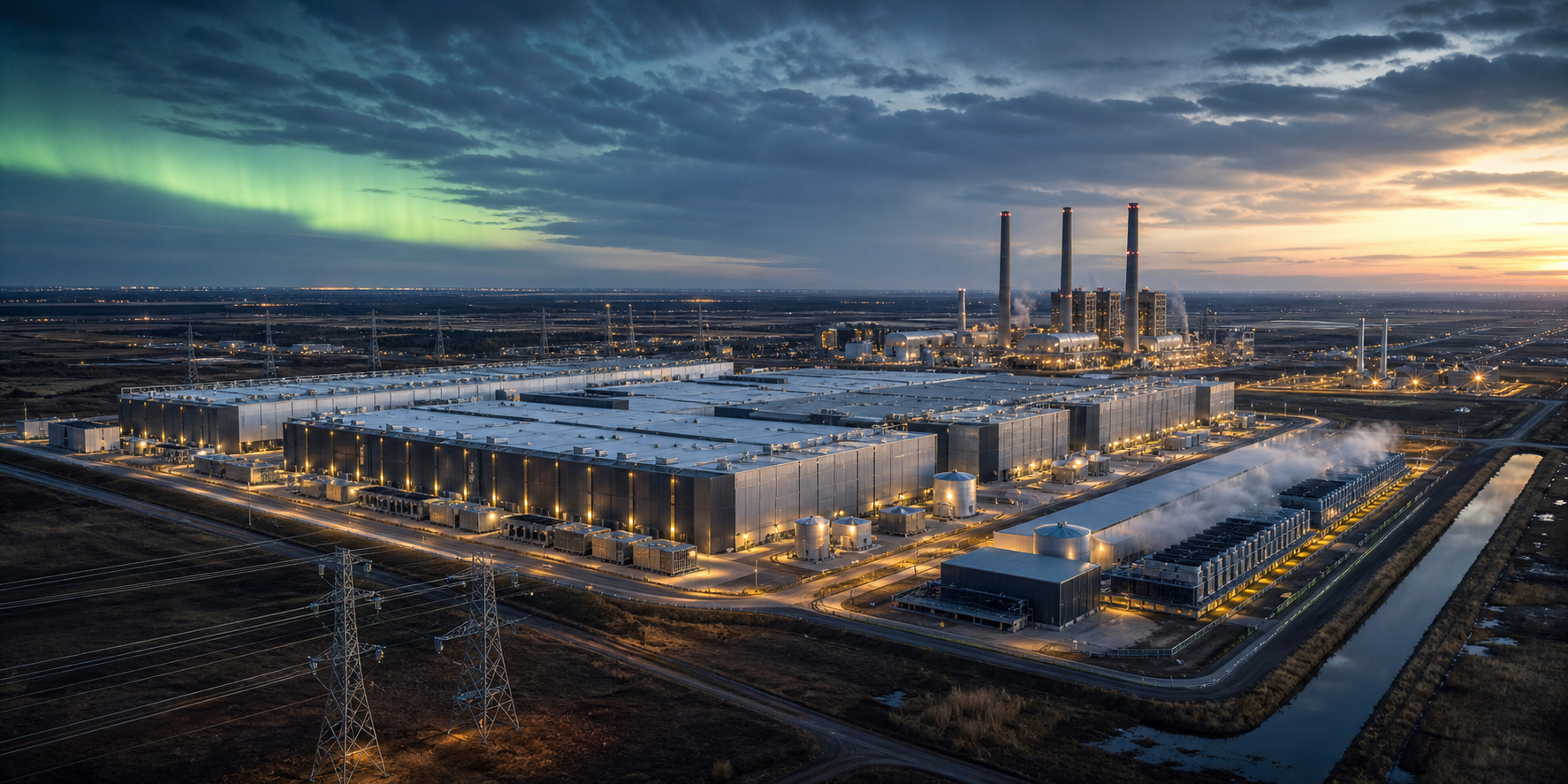
This is why the associated power announcements matter so much. On July 8, 2026, Capital Power disclosed a long-term energy supply agreement for 250 MW of capacity and energy in support of Meta’s Sturgeon County facility, with the load anticipated to be in service in the back half of 2028. A week earlier, Pembina, Morgan Stanley Infrastructure Partners, and Kineticor announced a positive final investment decision on the Greenlight Electricity Centre, described in the official release as a 932 MW combined-cycle gas power plant that will supply power on a dedicated basis to the customer’s data centre, with the site permitted to expand to 1,864 MW.
That pairing tells us more than the usual site announcement ever could. It suggests a phased energization model: a bridging period in which Meta can begin bringing part of the campus online before the full behind-the-meter generation stack is ready, followed by a later handoff to the dedicated Greenlight plant.
There are also already signs that the public record is a little messy, which is exactly why surface-level reporting is not enough. Sturgeon County’s release refers to Greenlight as a $4.6 billion, 970 MW natural-gas-fired facility. Pembina’s own final investment decision release says 932 MW. Kineticor’s project page still lists the facility as a proposed 1,864 MW plant with 2029 commercial operations, while AP’s July 8 reporting says the 932 MW initial plant is expected in the second half of 2030. Those are not trivial differences. They suggest either stale project pages, rounded public messaging, or multiple ways of describing phased capacity.
The safe conclusion is this: the initial dedicated plant is officially 932 MW in the latest project release, the site is permitted for 1,864 MW, and the bridging arrangement appears designed to let Meta energize some portion of the campus well before the full dedicated generation project reaches service.
That is a very different operational picture from “Meta built a data centre in Canada.” It is closer to “Meta assembled a compute-and-power campus whose timeline depends on staged energy availability.”
Why Alberta Was Attractive Even Before the Ribbon Cutting
There is a temptation to explain this site selection with one variable. Cheap land. Cold weather. Natural gas. Friendly government. Pick your favourite. Reality is more interesting because the project appears to require all of them at once.
Start with land use. Sturgeon County sits inside Alberta’s Industrial Heartland, which is not just empty space with a convenient highway nearby. It is an industrial zone built for large-load, large-footprint projects with the political and regulatory muscle memory that comes from hosting heavy industry. That matters because a gigawatt-class AI campus is not behaving like an office park or even a normal commercial technology build. It is behaving more like critical industrial infrastructure with a heavy digital payload.
Then add the provincial stance. Alberta has not merely welcomed data centres in the abstract. It has been building a policy case around them, including the requirement that large projects pay their own way on power and infrastructure. Whether one agrees with the policy is a separate question. From a developer’s perspective, the value is clarity. Meta knows the rules of engagement: bring generation, fund transmission and local upgrades, satisfy water constraints, and build on suitable industrial land.
Then add climate. Cold climates do not magically eliminate cooling requirements, but they do improve the economics of dry cooling and broader thermal rejection strategies. That matters more in the AI era because the cooling problem has become structurally harder. Meta says the Sturgeon facility will use a “water efficient closed-loop, liquid-cooled system with dry cooling,” and that there will be no operational water use in the cooling system itself. In a sector increasingly criticized for water stress, that is a strategically important design choice, especially in a region where public debate about water is not theoretical.
Finally, add fuel and generation economics. Alberta gives this project access to gas supply, industrial-scale generation development, and a market structure willing to treat dedicated power for AI infrastructure as a growth sector rather than an anomaly. Pembina’s congratulatory release is blunt about the commercial thesis: dedicated gas-to-power infrastructure for data centres is now a promising growth platform.
Put those pieces together and Alberta starts to make more sense. This was not just a place willing to host servers. It was a place willing to host an AI industrial complex.
What “AI-Optimized” Probably Means Here, and What We Still Cannot Prove
This is where the conversation usually falls apart. Some reporting jumps straight from “AI-optimized” to very specific claims about rack densities, chip generations, or exact cooling topologies at the Sturgeon site. Some reporting does the opposite and treats “AI-optimized” as a vague marketing phrase with no practical content. Both responses are lazy.
There is a more disciplined middle ground.
What we can say confidently is that Meta has already described, at the company level, where its AI infrastructure is headed. Meta’s 2023 AI infrastructure overview says its next-generation facilities are designed to support liquid-cooled AI hardware and high-performance AI networking. Meta’s March 2026 MTIA roadmap post says the company has deployed hundreds of thousands of MTIA chips in production and is iterating rapidly across new generations of its in-house accelerator family. Meta’s Open Compute work also shows the company pushing rack-and-power designs such as Open Rack v3, including 48VDC distribution, larger battery backup capacity, and accommodation for multiple forms of liquid cooling.
That gives us a credible picture of the design envelope around Sturgeon without pretending we have the final mechanical schedule.
What we cannot honestly claim yet is that Meta has publicly confirmed, for this specific campus, the exact rack power densities, the exact balance between MTIA and third-party accelerators, the exact hall-level cooling topology, or the exact network fabric layout. Those details may eventually become public through engineering posts, planning documents, or supplier disclosures. They are not clearly public yet.
Still, the implications are hard to miss. If Meta is building a 1 GW AI-optimized site that uses closed-loop liquid cooling and dry cooling, then the campus is almost certainly being shaped around accelerator-density compute rather than legacy air-cooled commodity fleets. If the project is large enough to justify a dedicated 932 MW plant with permitted expansion to 1,864 MW, then the design assumption is not modest incremental growth. It is sustained hyperscale AI demand. If Meta’s current infrastructure strategy is built around liquid-cooled hardware, high-performance AI networks, and custom silicon alongside GPUs, then it would be odd for its newest marquee AI campus to be architecturally conservative.
That is the key discipline here: reasonable inference, clearly labeled. Not fantasy presented as leaked truth.
The Water Story Is Real, but It Is Not the Whole Environmental Story
One reason this project has generated so much public reaction is that AI infrastructure is now colliding with environmental scrutiny in a much more direct way than social media platforms did in their earlier growth phase.
Meta is trying to answer that scrutiny with a facility-level design story that is stronger than many critics probably expected. The company’s own Sturgeon page says the cooling system will use no operational water for cooling, and annual operational water use at the campus will be limited to domestic use, fire protection, and equipment maintenance, projected to be less than one typical golf course or a 50-acre canola farm in the region. Sturgeon County repeats the same core point in its July 8 release.
If that design performs as described, it matters. Water has become one of the most politically combustible issues in the data centre sector because traditional evaporative cooling can externalize real local costs. A dry-cooled closed loop does not eliminate environmental impact, but it does attack one of the sector’s most contentious pressure points.
The problem is that some of the public discussion treats this water story as if it settles the sustainability question. It does not.
The electricity story cuts the other way. Meta says the site’s electricity use will be matched with 100% clean and renewable energy. That is a familiar corporate framing, and in accounting terms it may be true through power purchase agreements and other procurement instruments. But that should not be confused with saying the facility will be physically powered in real time by carbon-free generation. The same public record also tells us the site’s dedicated power backbone is a gas-fired combined-cycle project.
Those two facts can coexist. They just mean different things.
At the facility-design level, Sturgeon appears to be more water-conscious than many people assumed. At the electricity-supply level, it is still part of a buildout tied directly to new gas generation. Greenlight’s official materials emphasize efficiency and carbon-capture optionality, but optionality is not the same thing as installed carbon capture. That distinction matters because the public relations language around “clean energy matching” can easily outrun what physically happens at the meter.
The mature reading is neither “Meta solved sustainability” nor “everything about the project is greenwashing.” The mature reading is that Meta seems to have made a serious design decision to reduce cooling-water pressure, while still relying on a conventional dispatchable power strategy to make a gigawatt-scale AI campus feasible in the first place.
That tradeoff is probably not temporary. It may be the template.
What We Still Do Not Know, and Why Those Gaps Matter
There is already enough public information to say this is one of the most consequential AI infrastructure projects in Canada. There is not yet enough public information to pretend we know the whole machine.
Several gaps matter.
We do not know the exact deployment schedule inside the campus beyond the broad power milestones now on the record. We do not know how much of the physical site will be energized in the bridging phase versus waiting for Greenlight. We do not know the exact hall count, building sequencing, or how publicly reported square-footage and acreage figures break down across compute, support, and infrastructure uses. We do not know whether the eventual expansion toward 1,864 MW is a firm operational intention or simply a permitted option that may never be fully exercised.
We also do not know the exact server mix. Meta is very public about the direction of its AI hardware program, but not yet about how that mix lands in Sturgeon specifically. There is a difference between knowing Meta uses MTIA as part of its broader AI infrastructure strategy and knowing what percentage of this Alberta campus will be allocated to MTIA inference, GPU-heavy training, or more conventional fleet workloads.
And then there is governance. The province says the project will reduce transmission costs for ratepayers by up to 6%, but the public-facing explanation of that number is still thin. Maybe the math works. Maybe it is directionally right but politically smoothed. Either way, a claim like that deserves more than applause lines.
That does not weaken the story. It improves it. The right way to read a project like this is not to demand omniscience on day one. It is to separate what is confirmed, what is probable, and what remains unresolved.
On the confirmed side, Meta is building a huge AI campus in Sturgeon County, backed by more than CA$13 billion, dry-cooled liquid infrastructure, a 250 MW bridging supply agreement, and a dedicated gas-fired generation project whose initial official phase is 932 MW. On the probable side, the campus is being shaped around the same liquid-cooled, high-network-density design logic Meta has already described elsewhere for its AI era. On the unresolved side, the exact compute topology, expansion path, real-world emissions posture, and long-term economics are still only partially visible.
That is already more useful than most headlines.
The Bigger Meaning of Sturgeon County
The Alberta project matters not just because it is large, but because it clarifies the shape of the industry.
For years, people talked about AI infrastructure as though the frontier challenge were mainly model quality. That is no longer credible. The frontier is now civil, mechanical, electrical, and regulatory at the same time. The winners will not merely be the companies with strong models. They will be the ones able to secure power, land, cooling, and transmission on timelines that match silicon demand.
Sturgeon County makes that visible in concrete terms. Meta did not announce a software release. It announced a multi-billion-dollar physical stack tied to a regional energy strategy. That is what the AI economy looks like once it leaves the cloud metaphor behind and starts showing up as gas turbines, substations, water approvals, rack power architectures, and dry-cooling loops.
So yes, this is a story about Meta. But it is also a story about where digital infrastructure is going. The next era of hyperscale AI will not be built by companies that think in app layers alone. It will be built by companies that can integrate compute design with power engineering, environmental constraints, supply chains, and policy formation.
That is why the most important building in this story may not be the data hall at all. It may be the power plant next door.